· Wes Halloran
Flirt Pole Problems, and the Fix for Each One
A lure on a cord is a simple object, and the first session usually goes well enough that nobody reads anything. The second week is where the questions start. The dog begins going for the handle. The dog catches the lure and walks off with it. The dog that sprinted flat out on Monday looks at you on Thursday and wanders off to sniff the fence.
None of that means the game has failed. One part of it has drifted, and the parts are few enough to check one at a time.
Three checks before you blame the dog
Run these first, because they cause more of the list below than anything to do with temperament.
Surface. Grass or packed dirt. Not tile, not laminate, not a wet patio. Height. The lure stays on the ground or just above it, and nobody lifts it to make the dog leap. Catch rate. The dog wins the lure regularly, not once at the end. The reasoning behind all three is set out in what is a flirt pole, so it is not repeated here.
| What you are seeing | Where to look first |
|---|---|
| Biting the pole rather than the lure | The lure is travelling towards the dog, or too slowly |
| Crashing into you, teeth on a hand | You are standing inside the running line |
| Will not release the catch | Letting go currently ends the game |
| Quits after two minutes | Sessions running long, or catches too rare |
| Wired afterwards instead of settled | No wind-down at the end |
| Suddenly cautious, running wide | The dog slipped, probably once |
The dog goes for the pole, or for you
Two symptoms, one cause: the lure is not where the dog thinks it is going.
It bites the handle instead of the lure
This is the most common one, and it is nearly always geometry rather than disobedience. A dog cuts corners because cutting corners works. If the lure keeps passing close to your hand, the shortest route to it runs through the handle, and a dog that has taken that route twice will take it every time.
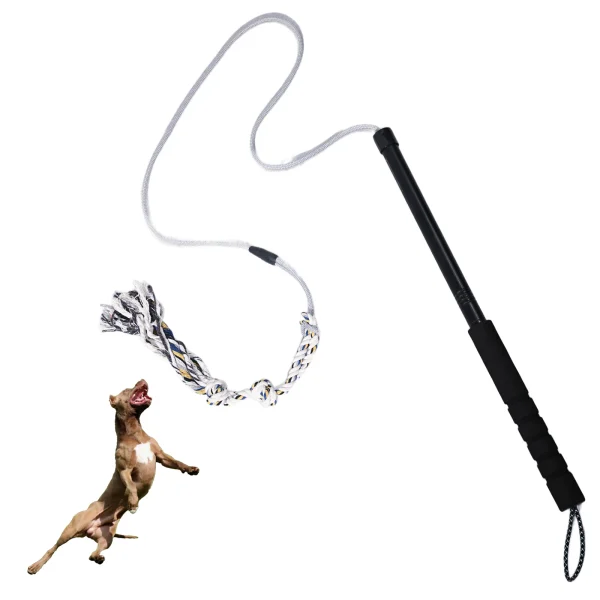
The fix is to make the lure the far end of everything. Sweep it away from the dog, never towards it, in a wide circle with you turning on the spot at the centre. Use the whole cord: on this pole the 43.3 inch cord runs off a 20.4 inch handle, which puts the lure roughly five feet from your hand at full stretch, and five feet is the margin doing the work.
For a dog that has already learned the shortcut, add one more move. The moment its attention swings to the handle, stop the lure dead on the ground. Restart it the instant the dog looks back at the lure. You are not correcting anything, you are making the two options pay differently, and dogs sort that out quickly. That a chase toy must travel away from the dog rather than towards it is the first of the three tests in our dog chase toy guide.
It runs through you, or takes a hand on the way past
Same cause, different symptom. If the dog is arriving at you, the lure was somewhere behind you when the dog committed. A tight circle does that constantly, because the lure spends half of every revolution on your side of the dog.
Widen the arc until the dog is orbiting you rather than crossing you, and turn with the dog so your body stays outside the running line. Never let the lure pass between your legs, and never walk backwards while sweeping, which is how you end up in the lane you just sent the dog down.
When teeth do land on skin, the useful response is not a raised voice. Stop the lure, stand still, and let a few seconds of nothing happen before the game restarts. In a game the dog wants, the game pausing is the whole consequence, and it lands far better mid-arousal than anything said out loud.
The dog catches it and will not give it back
Look at what releasing has cost the dog so far. In most households, letting go is the exact moment the session ends and everyone goes indoors. The dog has learned the sequence perfectly, which is why it now holds on.
Bring food to the nose, say your cue once, and then, the moment the lure is dropped, start it moving again. The restart is what buys the release. Food alone teaches a dog to swap; food followed by the lure running again teaches a dog that letting go keeps the game alive. The cue itself is laid out step by step in dog training for prey drive.
Two things to avoid while you are fixing it. Do not chase the dog, because a dog carrying a trophy away from a pursuer has just been given a second game. And do not haul on the cord, because that turns the lure into a contest to be won rather than a prize to be traded, which is how guarding gets built.
steps in the predatory motor sequence, from orienting on movement to consuming — the grab is a link the dog is built to complete, not a bad habit
— Coppinger & Coppinger, Dogs: A Startling New Understanding, 2001
The dog quits after two minutes
A dog that was keen and is now flat has usually been run past the point where the game stayed fun. The sprint-brake-turn pattern costs far more than it looks, five to ten minutes is a full workout for most dogs, and a dog stopped early stays enthusiastic while a dog run flat every time starts to opt out. If the last few sessions ran long, the repair is a run of deliberately short ones.
The second cause is a catch rate that has quietly dropped. Chasing something that can never be caught is frustrating rather than satisfying, and dogs answer frustration by disengaging. Count the catches in your next session.
Heat is the third, and it is the one owners underestimate: sprint work in warm weather is much harder on a dog than a walk in the same weather, so early morning and late evening, and shorter. The routine that balances all three sits in how to tire out a dog that never gets tired.
There is also the dog that never really started. Prey drive decides this, not breed or size, and a dog that would rather work one hedge for ten minutes may look at a lure politely and go back to the hedge. That is a temperament reading rather than a technique fault, and the 30-day returns cover it.
The dog is more wound up afterwards, not less
The chase raises arousal on purpose. What decides the evening is how the session ends, and the most common mistake is stopping dead the moment the last catch happens. A dog dropped out of a high-arousal game with nowhere to go starts looking for the next one, usually in the kitchen.
Give it a landing. Scatter a handful of kibble in the grass and walk away. Two minutes of sniffing brings a dog down where two minutes of standing about does not, and it costs nothing.
pet dogs given nosework sessions shifted toward a more optimistic judgment bias than dogs given heelwork training
— Duranton & Horowitz, Applied Animal Behaviour Science, 2019
The other half of the answer is the catch again. A dog that won several times has completed something; a dog that never closed its jaws on anything is still hunting when you put the pole away. Let the last catch of the day belong to the dog.
The cord keeps wrapping round a leg
The cord is the part most likely to wrap around a leg, yours or the dog's, and length makes it worse rather than better. Keeping it short enough to control matters more than having a long one.
Most wraps come from reversing direction mid-arc. Sweep one way and stay with it, and when you do change direction, let the lure come to a stop first. Keep it on the ground, because a cord travelling at ankle height is the one that catches a leg, and turn with the dog rather than letting it cross your line.
If a wrap does happen, stop everything. Do not pull, and do not let the dog keep running to free itself. Drop the handle, walk to the dog, unwind it, and start again. A dog that has been dragged off its feet by a cord once takes a long time to forget it.
The dog slipped once, and now holds back
A dog that slips holds back afterwards, and it holds back on every surface, not just the one that caused it. What you get is a dog going through the motions at half speed, running wide, refusing to commit to the turn. Owners usually read it as boredom.
Move to grass or packed dirt if you have not already, and rebuild confidence rather than intensity. Open with a minute of slow sweeps at walking pace before anything sharp. Keep the arcs wide so the turns are gentle. Pay generously with catches, because the catch is what makes committing feel worth it again. Speed comes back on its own once the dog trusts the ground.
On the weeks when there is no safe surface outside at all, the ice and the third day of rain, the indoor version of the game is a slow one and it works differently: tiring out a high-energy dog indoors sets that out.
When the problem is the kit, not the dog
Three of these come up often enough to be worth naming separately.
The assembled pole feels bulky. The padded foam grip screws onto the handle and comes off, which drops the whole thing to a length that fits a car door pocket or a hook by the back door. It is the most common thing buyers say about this pole.
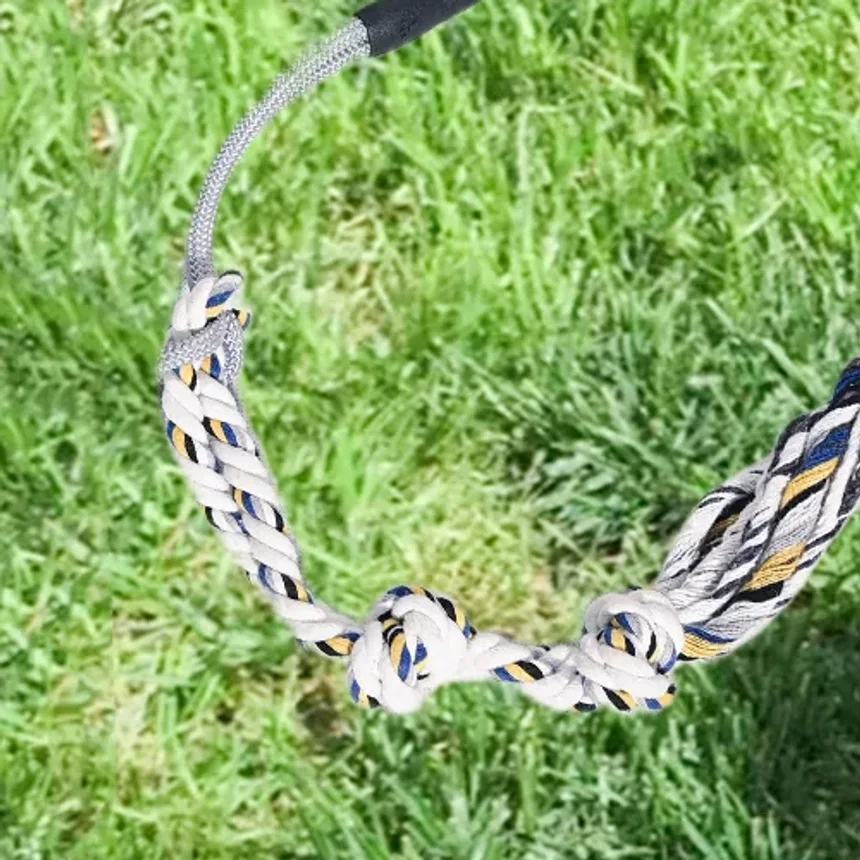
The lure is coming apart. Braided cotton compresses under a bite and springs back, which is why it survives grabbing better than the flat nylon webbing on cheap poles, and the frayed tassel at the end is a target rather than a fault. A lure that has genuinely started to unravel into loose strands is different: dogs that swallow strands can end up in surgery, so retire it. The lure unties, so it can be replaced without replacing the pole.
The handle worries you. Across 27 verified ratings of this pole, nobody reports a snapped handle or a rope pulled apart, including the buyer running it with a Rottweiler crossed with a Dogue de Bordeaux.
The problem that is not a problem
A puppy still growing, or a dog coming back from a joint, ligament or soft-tissue injury, does no chase work until a vet has said that dog can turn hard at speed again. There is no gentle version of a hard turn, so this is not a technique to be adjusted. It is a wait, and the sniffing games in the indoor guide fill it well.
Everything above is one of two things: a lure moving in the wrong place, or a dog not allowed to win often enough. Read a few sessions with those two questions in hand and most of the list stops appearing. What the toy is and which dogs take to it is covered in what is a flirt pole, and where it sits against everything else on the shelf is in toys for high-energy dogs. The pole itself is here.

Wes Halloran · Canine enrichment writer
Wes writes about exercise for dogs whose energy outlasts the walk.