
· Wes Halloran
DIY Flirt Pole: How to Make One, and Where Homemade Fails
The search usually starts in the same place. The dog has been walked, the dog is still going, and somewhere between the fourth toy and the second lap of the kitchen you find a video of somebody sweeping a length of pipe around a garden while a dog turns itself inside out chasing it. A tube, a rope, a rag.
It genuinely is that simple, and a first attempt usually works well enough to convince you. What the video leaves out is week three, which is decided by details that cost nothing at the bench and cannot be fixed once a dog is running.
What you are building, in three parts
Every version of this toy is a lever, a line, and something on the end of the line that a dog wants to get its teeth into. The lever gives you reach, so the lure travels much further than your arm and you turn on the spot instead of running. The line gives the lure a delay: it lags, whips and changes direction a beat after your hand does, and that lag is what makes it unpredictable enough to be interesting.
The lure supplies the ending. A dog that chases something it can never catch gets frustrated rather than satisfied, which is why the part that looks like an afterthought is the part the session hangs on. Why the sprint-brake-turn pattern empties a dog faster than distance does is set out in what is a flirt pole.
steps in the predatory motor sequence, from orienting on movement to consuming — the grab is a link the dog is built to complete, which is why the lure has to be catchable
— Coppinger & Coppinger, Dogs: A Startling New Understanding, 2001
The parts list, and what each part has to survive
Three parts, three different loads. Getting any one of them wrong produces the pole that lasts a fortnight.
The tube
Rigid, thick-walled, smooth, and light enough to sweep one-handed for several minutes without your shoulder giving out. Plastic conduit is the usual choice because it cuts with a hacksaw and costs very little. What it has to survive is not the sweeping: it is a dog's full body weight arriving at the end of a cord, sideways, several dozen times a session.
Two popular substitutes fail in ways the material predicts. A wooden broom handle splits along the grain from any hole drilled in it. Bamboo splinters into exactly the shape you do not want near a mouth. Thin-walled tube crushes where your hand grips it, and once the section is oval it cracks.
The cord
Braided, soft, and not elastic. It takes the shock of the catch and the abrasion of running across the lip of a drilled hole. Thin nylon line cuts into its own knot and eventually parts, and it is also the part most likely to wrap round a leg, yours or the dog's.
Length is where homemade builds overreach, because more cord feels like more chase. It is not: a long cord is harder to control, wraps more, and drags the lure through the dog's own path. For a ratio to copy, the pole we sell publishes a 43.3 in (110 cm) cord on a 20.4 in (52 cm) handle — a little over twice the handle, and no more.
The lure
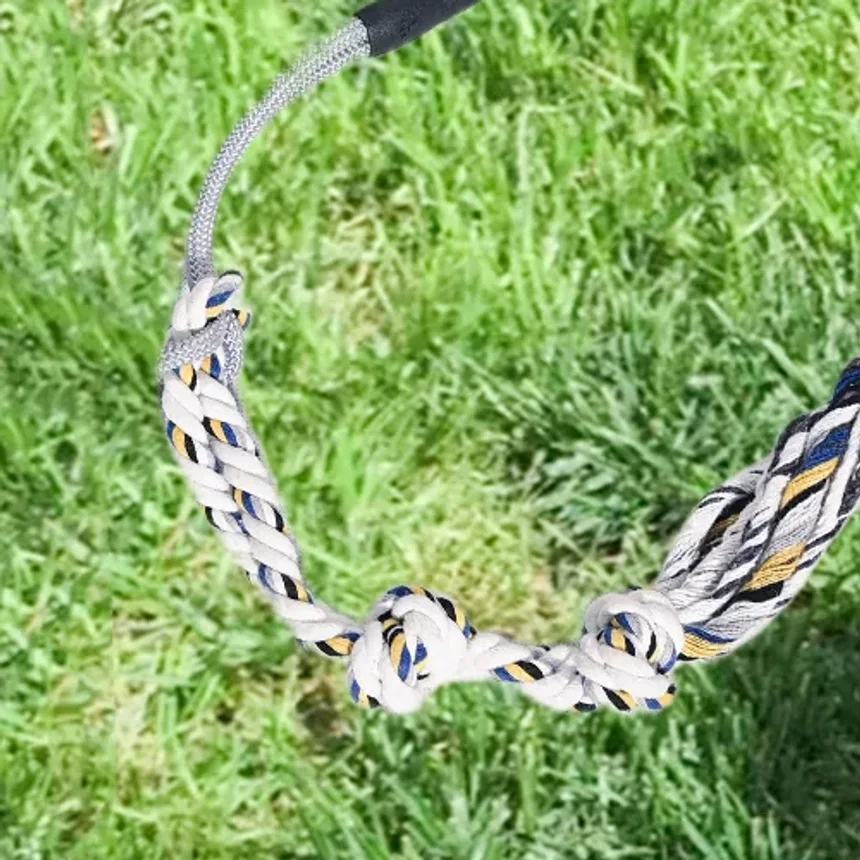
One piece of soft material, with nothing attached to it. Braided cotton rope, fleece, or an old towel cut into strips and plaited all move well enough. What matters is how the material behaves under a bite rather than how it looks on the grass.
Flat nylon webbing and single strips of fleece both tear along a seam once a dog with any jaw strength gets hold of them. Braided rope behaves differently, because it compresses under a bite and springs back instead of splitting, and a frayed end gives the dog an obvious target to aim the grab at. Which properties actually make a chase toy work is the three-part test in our dog chase toy guide.
Building it, in order
Six steps, and the third is the one everybody skips.
- Cut the tube. Take it to a length you can sweep in a full circle, one-handed, without the tip catching the ground or your own legs. Longer is not better: every extra inch is leverage the dog uses against your wrist.
- Drill one hole through both walls, near the tip. Straight through, so the cord enters one side and leaves the other. A second anchor point lower down gives the tube two places to crack instead of one.
- Sand every cut edge, and both lips of the hole. Inside and out. A drilled edge in plastic is a blade, and the cord will run across it thousands of times. This step is why one homemade pole lasts a season and an identical one parts mid-session.
- Thread the cord and stop it. Finish with a stopper knot fat enough that it cannot pull back through the hole under load. Test that by hauling on it with both hands, not by looking at it.
- Knot the lure onto the far end. Use a knot you can undo. The lure wears out first, and a build where it comes off for replacement is a build you keep rather than rebuild.
- Run it once without the dog. Sweep a few full circles, watch where the cord sits at the hole, and put your weight on the lure knot one more time.
The safety rules that matter more than the build
A rough pole used well beats a beautiful pole used badly. Three rules do most of the protecting, and none is about craftsmanship.
The turn is what costs a dog
This toy earns its results through hard acceleration and braking, and those forces go through joints. Work on grass or packed dirt, never on tile, laminate or a wet patio. Keep the lure on the ground or just above it, and do not lift it to make the dog leap: a dog twisting in mid-air lands badly, and landing badly is how dogs hurt knees.
A puppy still growing, and any dog coming back from a joint, ligament or soft-tissue injury, does no chase work until a vet says that dog can turn hard at speed again. There is no gentle version of a hard turn, so this one is a wait rather than a technique to adjust, and the sniffing games in tiring out a high-energy dog indoors fill it well.
Nothing on the lure that can come off
This is where homemade builds get inventive and should not. A tennis ball taped on, a squeaker sewn in, a clip or carabiner joining cord to lure, cable ties trimming an end: every one of those is a small hard object inside the jaws of a dog biting at full commitment. Dogs that swallow strands or fragments can end up in surgery.
One piece of soft material, knotted, with no hardware anywhere on it. Retire a lure that has started to unravel into loose strands, and check it at the end of a session rather than at the start of the next one, when the dog is already bouncing.
Elastic cord does not belong on a flirt pole
Bungee cord looks like an upgrade and behaves like a hazard. Elastic stores energy every time the dog loads it, and when the knot slips or the lure comes free that energy comes back along the line towards whoever is holding the handle, at roughly face height. It also spoils the game: the recoil snatches the lure away as the dog commits to the grab, which builds frustration into every rep. Braided, non-elastic cord only.
Where a homemade pole gives way
Three failures account for nearly all of them, one per part.
The tube cracks from the hole. Any hole in a rigid tube concentrates stress at its edges, cold weather makes most plastics more brittle, and the crack starts where you drilled. It rarely snaps cleanly: it splits along a line and leaves a sharp lipped edge, unpleasant on a hand and worse near a mouth, so a split tube gets replaced rather than taped.
The cord parts at the hole. Every sweep drags the same short section of braid across the same two edges, and unsanded plastic saws through it faster than owners expect. The failure comes mid-sprint, at the moment of highest load, and it sends the lure flying while the dog is running flat out at it. Move the cord through the hole every so often so the wear spreads, and replace it once the braid looks furred.
The lure shreds. Fabric strips and webbing tear along a seam and shed pieces. That is a swallowing risk before it is an annoyance, which is the argument for building the lure so it unties.
None of that shows up on day one. It shows up in the third week, which is why a homemade pole wants a ten-second inspection habit: hole, knot, lure. If the sessions start going wrong instead of the kit, that is a separate list — flirt pole problems and the fix for each one works through the nine most common.
The first sessions with a pole you made
Five to ten minutes is a full workout for most dogs, and a new build gets shorter sessions than that while you watch how it holds up. Sweep the lure away from the dog in wide circles, turning on the spot yourself, and let the dog cut the corner: a lure that keeps passing close to your hand teaches the dog that the shortest route runs through the handle.
Let the dog catch it regularly. When it does, either let it hold and tug for a few seconds, or bring food to the nose, say your cue once, and start the lure moving again the instant it is dropped — the restart is what buys the release, and the cue is laid out step by step in dog training for prey drive. End with a handful of kibble scattered in the grass: two minutes of sniffing brings a dog down where two minutes of standing about does not.
What a finished pole settles
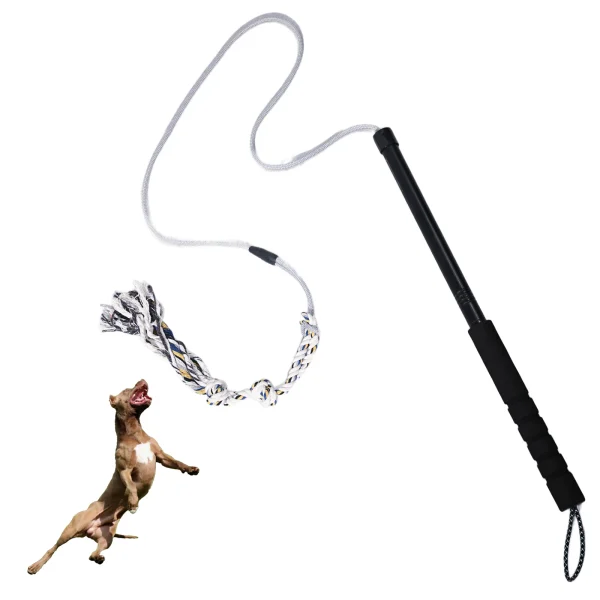
The three details a garden build keeps watching are the three the pole we sell hands over already settled. The lure is braided pure cotton finished in a frayed tassel, knotted so it unties and can be swapped without replacing the pole. The cord is 43.3 in (110 cm) on a 20.4 in (52 cm) telescopic handle, and the padded foam grip screws off, which drops the whole thing to a length that fits a car door pocket or a hook by the back door.
Across 27 verified ratings nobody reports a snapped handle or a rope pulled apart, including the buyer running it with a Rottweiler crossed with a Dogue de Bordeaux; the buyer reviews are all on one page. It ships free with 30-day returns.
Either way, the game is the same game, and the routine that gets the most out of it in the fewest minutes is in how to tire out a dog that never gets tired. The pole itself is here.

Wes Halloran · Canine enrichment writer
Wes writes about exercise for dogs whose energy outlasts the walk.