
· Wes Halloran
Flirt Pole vs Spring Pole: One You Steer, One the Dog Works Alone
They get filed together because both are sold to the same owner: the one whose dog is still bouncing after a long walk. Side by side they have almost nothing in common. They ask different things of the dog, very different things of you, and only one of them lets you decide how hard the next thirty seconds will be.
One is a chase. The other is a pulling contest
A flirt pole is a handle, a cord and a lure on the end of it. You sweep the lure along the ground and it runs away from the dog, cuts left when the dog commits right, and gets caught when you let it. The full description of the toy and where it comes from is in what is a flirt pole.
A spring pole is a tug hung from a fixed point overhead, usually with a spring or a length of elastic somewhere in the line. The dog takes it in its mouth, braces its feet and pulls. The line gives, and when the dog lets go the line takes the slack back. That is the whole mechanism, and every version of the object works the same way.
Dog chase toys sets out a three-part test for chase toys: the thing has to move away from the dog, change direction, and end up caught. A hanging tug does none of those. It is tied at one end, nothing is steering it, and it does not need catching because the dog is already holding it.
So a spring pole is not a chase at all: it is the grip and the pull on their own, with the run taken out. A flirt pole runs the sequence whole — the sprint, the brake, the turn, the decision to commit, and the bite at the end.
What each one asks of you
The flirt pole asks for your hands and your attention for the length of the session. Every change of direction comes out of your wrist. Every catch happens because you allowed it. There is no version of this toy that works without you on the end of it.
The spring pole, once it is up, asks for nothing. The dog starts it, the dog stops it, and it does that while you are indoors. That is a real advantage and it is the reason people put them up: it is a pulling game a dog can have without a person on the other end.
The cost sits at the far end of the line. The whole thing hangs off an anchor, and what a given anchor will take is a question about one specific beam, branch or frame in one specific garden. Nobody publishes a load rating for a tree limb. This guide does not tell you how to rig one, because the number that matters is not one anyone can give you from a distance.
There is a second difference in that. An object a dog bites unwatched also fails unwatched. A lure on a handle fails in front of the person holding it.
The same logic decides where elastic belongs. The DIY guide keeps bungee cord off a flirt pole, and the reason is not that elastic is bad. Elastic stores energy, and on a hand-held line that energy comes back along the cord towards the hand holding it, at roughly face height. On an anchored line nobody is standing in the line. Same material, opposite verdict.
What each one asks of the dog
A flirt pole session is a set of sprints with a decision in each one. The dog accelerates, brakes, plants a foot and turns on one shoulder, tracks a target that keeps changing its mind, and closes on it. The turning is the expensive part, which is why a few minutes of it does what a much longer walk does not.
A spring pole session is holding something against resistance. Jaw, neck, shoulders, back, and legs braced into the ground. That is genuine whole-body work — gripping and pulling is one of the three things that actually cost a dog energy, as how to tire out a dog that never gets tired explains — but it is strength work standing still, not a chase.
Being fit for one does not make a dog fit for the other. A dog that pulls like a crane may have no interest in running after anything, and a dog that fixes on every moving leaf may hold a static rope for four seconds and wander off. What settles it is not the breed but what your dog already does without being asked.
Who decides how hard the session gets
On a flirt pole the dial is in your hand and it moves continuously. You open with slow sweeps at walking pace so the dog warms up instead of launching cold. You can take the heat out of a rep without ending the game by stopping the lure dead on the ground. You let the dog win to close a sequence, trade the lure for food, and start again at whatever speed you choose. And you end it while there is still enthusiasm left, which is what keeps the toy interesting next time.
On a spring pole the dial belongs to the dog, and a dog that is enjoying itself is a poor judge of when it has had enough. The same holds for ball throwers, as toys for high-energy dogs explains: give a driven dog a game it can repeat without a person moderating it, and some dogs will keep going past the point where a person would have called it.
Being the brake is work, and it is the part nobody advertises. It is also why a ten-minute session ends where you meant it to.
The ground each one needs
length of an AKC lure coursing course, laid out across an open field — the ground both of these home versions have to do without
— American Kennel Club, 2026
Lure coursing needs a field and a lure operator. Both of these toys exist because most people have neither, and they solve that in opposite directions.
The flirt pole keeps the course and folds it into a ring around you. The pole we sell runs a 43.3 inch cord off a 20.4 inch telescopic handle, which puts the lure about five feet from your hand at full stretch, so the ring the dog runs is a few metres across and you stand still in the middle of it. It does need the right surface: grass or packed dirt, never tile, laminate or a wet patio, because the hard turn is the valuable part and a slippery floor is what punishes it.
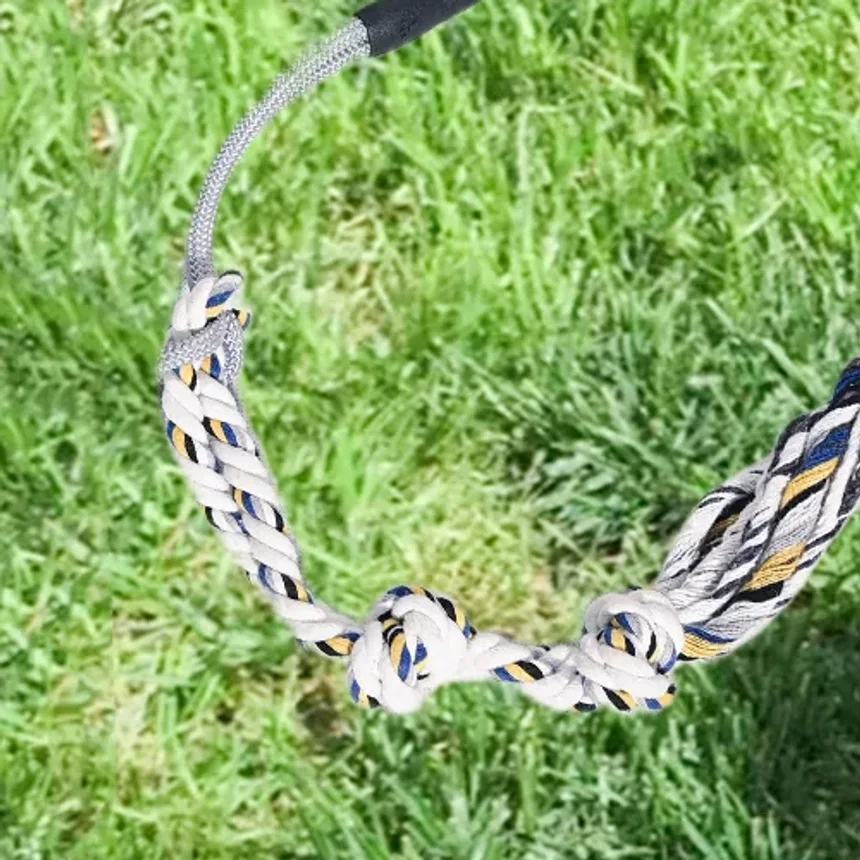
The spring pole removes the course entirely. The dog stays under the anchor, so the ground it needs is barely more than the dog. What it needs instead is a solid overhead point with clear ground under it, and in a small garden that is harder to come by than a patch of lawn.
Height, and the dog that leaves the ground
The rule this site repeats about a flirt pole is to keep the lure on the ground or just above it. A dog that leaps for a lure comes down badly, and the landing is where knees and shoulders pay. That rule is enforceable because the height is in your hand: if the lure is too high, you lower your arm.
A hanging tug sits at height because that is how it is built. The dog reaches up to take it, and a dog holding on above its own shoulder line has its weight somewhere its legs are not. Nobody in that system can lower it mid-rep. That is not a reason to be alarmed about the object, but it is a real difference in what the format does, and most comparisons of the two leave it out.
Growing dogs are the case where this matters most, and the nearest thing to a published threshold comes from the sport both toys borrow their lure from: the American Kennel Club states that eligible sighthound breeds can compete in AKC lure coursing after reaching their first birthday.
the point at which eligible sighthound breeds may first compete in AKC lure coursing, the sport both of these games take their lure from
— American Kennel Club, 2026
That is an entry rule for a competition, not a veterinary threshold for your dog, and it was never written about garden toys. Dogs finish growing on their own schedule and it varies by size and by individual. If your dog is still growing, the person who sets the limit is your vet, because your vet can see the dog and a website cannot.
The same applies at the other end. A dog coming back from a joint, ligament or soft-tissue problem does neither of these games until a vet has said that dog can load a joint at speed again. There is no gentle version of a hard turn and no gentle version of a full-body brace, so this is a wait rather than a technique to adjust.
How each session ends
Both games raise arousal deliberately. What decides the rest of the evening is how the dog comes down from it.
A flirt pole hands you the ending. The last catch of the day belongs to the dog, so the sequence is completed rather than interrupted, and then you give it a landing: scatter a handful of kibble in the grass and walk away, and let sniffing do the settling. That, and the other eight things that go wrong in a session, are laid out in flirt pole problems.
A spring pole ends when the dog stops pulling, and the moment a dog stops pulling is not automatically the moment it is settled. There is no landing built into it, because there is nobody there to give one.
There is a line past which none of this is about the toy. If a dog redirects onto people or other dogs when it is wound up, guards what it has caught hard enough that getting it back is a fight, or cannot come down for hours after any high-arousal game, changing the object in your hand will not fix it. That is the point to bring in a qualified behaviourist who can watch your dog work. The cues that put the game on a switch are in dog training for prey drive, and they are cues, not a replacement for someone who can see what is happening.
Which one your dog is asking for
| Flirt pole | Spring pole | |
|---|---|---|
| Who works it | You, for the whole session | The dog, on its own |
| What the dog does | Sprints, brakes, turns, commits, catches | Grips, braces, pulls |
| Who sets the intensity | You, sweep by sweep | The dog |
| Ground it needs | A ring of grass a few metres across | Almost none, under the anchor |
| What has to hold | Your grip on the handle | Whatever it is anchored to |
| Where the lure sits | On the ground, where you keep it | Overhead, where it is hung |
| How it ends | When you call it | When the dog lets go |
Read that as two answers to two different questions, not a ranking. A hanging tug answers "my dog needs something to pull and my hands are busy". A flirt pole answers "my dog needs to run at something, turn with it, and be allowed to win".
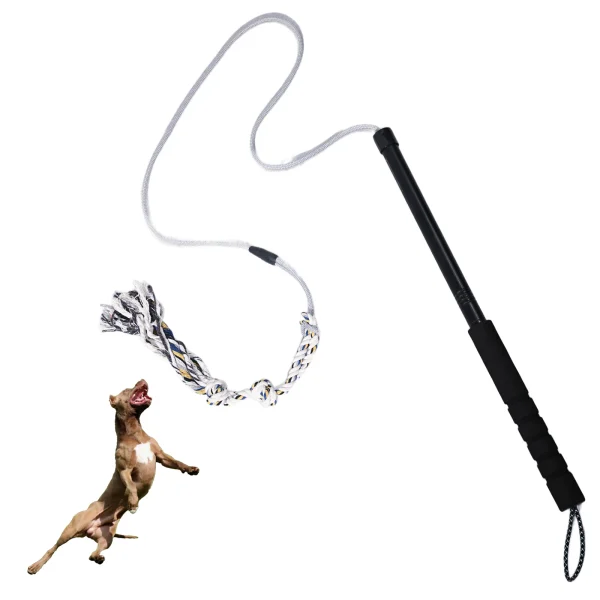
The useful question is which part of the sequence your dog is not getting. Pulling is the last link of it, and a lure that gets caught delivers that link every rep: the dog closes its jaws on the rope, braces, and pulls against you for a few seconds before the trade. What a hanging tug leaves out is everything in front of it. The run, the brake and the turn are where the ten minutes actually go, and that is the part a walk on a lead never triggers.
Our answer to it is a telescopic handle, a braided pure-cotton lure on a 43.3 inch cord, and a grip that unscrews so the whole thing fits behind a door. The rest of the specification, the buyer ratings and the session rules are on the product page.

Wes Halloran · Canine enrichment writer
Wes writes about exercise for dogs whose energy outlasts the walk.